
The web hosting market is crowded, with thousands of providers competing for customers. That creates opportunities for bloggers and affiliate marketers who publish trustworthy, honest hosting reviews.
If you’ve ever searched for a hosting company before launching a website, you’ve probably noticed that most hosting reviews look exactly the same. They recycle promotional content, copy feature lists, and rarely provide genuine experience. That’s precisely why learning how to write a high-converting hosting review has become one of the most valuable skills for bloggers and affiliate marketers. A well-written hosting review doesn’t simply attract visitors; it builds trust, solves problems, and encourages readers to make confident purchasing decisions.
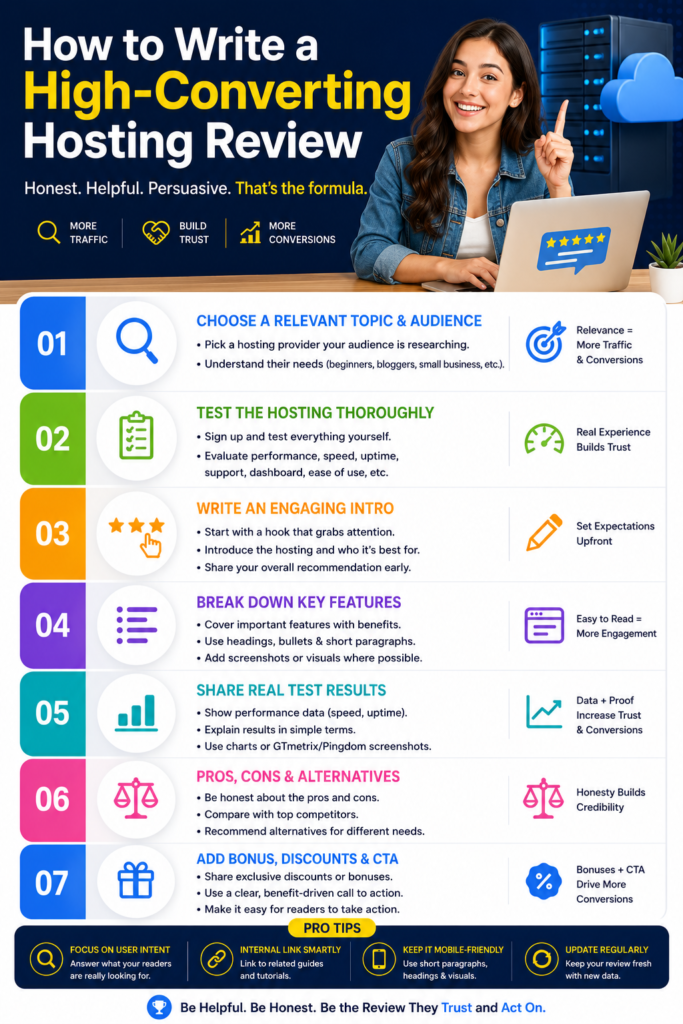
This guide will show you exactly how to write a hosting review that ranks well on search engines and converts readers into customers.
Why Learning How to Write a High-Converting Hosting Review Matters
The hosting industry is competitive, yet it remains one of the more popular affiliate niches. New websites are created every day, and every website owner eventually needs reliable hosting, which creates a steady stream of people searching for hosting recommendations.
The reason hosting reviews convert exceptionally well is simple: people searching for hosting reviews already have strong buying intent. They’re not browsing casually; they’re actively looking for the best solution to host their websites. Your role as a reviewer isn’t merely to describe features but to reduce uncertainty and help readers feel confident about their decision.
Think of yourself as a trusted friend rather than a salesperson. When readers feel that you’re genuinely trying to help them choose the right hosting provider, conversions naturally increase. Trust is the real currency of affiliate marketing, and hosting reviews provide one of the best opportunities to build that trust.
Understanding Your Audience Before You Write
Before writing even a single word, you must understand who you’re writing for. One of the biggest mistakes beginner affiliate marketers make is writing generic reviews for everyone. Unfortunately, content written for everyone typically converts nobody.
Ask yourself several important questions. Is your audience made up of beginner bloggers? Small business owners? WordPress users? E-commerce entrepreneurs? Developers? Each audience has different priorities and concerns. For example, beginners usually prioritize ease of use, affordability, and customer support. Developers, however, may care more about server resources, root access, and scalability.
Successful hosting reviews focus heavily on solving customer pain points. Many buyers worry about website speed, downtime, security, migration difficulties, hidden costs, and poor customer support. Address these concerns directly in every review you write.
When you understand these concerns, your review transforms from a simple product description into a practical buying guide.
How to Write a High-Converting Hosting Review Using Real Experience
One of the most important principles of how to write a high-converting hosting review is using real-world experience whenever possible. Readers can quickly identify whether a review is based on actual testing or merely rewritten promotional content.
Start by purchasing or testing the hosting service yourself. Measure page loading speed, server response times, uptime percentages, and customer support response quality. Take screenshots of the dashboard, control panel, website setup process, and performance tests. Real data builds immediate credibility.
For example, many hosting providers now advertise uptime of 99.9% or higher, performance tools and data centres in several regions. Compare what is actually advertised on the plan you are reviewing, and then check it yourself instead of repeating the sales page.
Personal experiences also make your content sound human. Instead of saying, “This hosting provider offers excellent performance,” explain what happened when you tested the hosting platform. Describe the setup experience, support interactions, and actual website performance. Stories convert better than specifications.
Essential Elements of How to Write a High-Converting Hosting Review
A high-converting hosting review follows a structured framework that guides readers naturally toward making a decision. Randomly listing features rarely produces strong conversion rates.
A successful hosting review should include:
| Element | Purpose |
|---|---|
| Introduction | Capture attention and establish credibility |
| Features | Explain capabilities and benefits |
| Performance Tests | Provide measurable evidence |
| Pricing | Help readers evaluate value |
| Pros & Cons | Demonstrate transparency |
| Customer Support | Build trust |
| Final Verdict | Encourage action |
Your introduction is especially important. Readers decide within seconds whether to continue reading or leave. Begin by addressing a specific problem or question your audience faces. For example, “Is this hosting provider actually worth your money in 2026?” immediately creates curiosity.
Feature explanations should focus on benefits rather than technical specifications. Instead of saying “NVMe SSD storage,” explain how faster storage improves website loading times and user experience. Remember, buyers purchase outcomes, not technical jargon.
How to Write a High-Converting Hosting Review with Honest Pros and Cons
Transparency is one of the strongest conversion factors in affiliate marketing. Ironically, acknowledging a product’s weaknesses often increases trust and improves conversions.
Every hosting provider has limitations. Some have higher renewal prices. Others may lack phone support or impose resource restrictions on entry-level plans. Rather than hiding these drawbacks, explain them honestly and provide context.
For example:
Pros:
- Fast loading speeds
- Beginner-friendly dashboard
- Affordable introductory pricing
- Reliable uptime
- Excellent security features
Cons:
- Higher renewal costs
- Limited advanced customization
- Some premium features require upgrades
When readers see balanced evaluations, they perceive your recommendations as trustworthy rather than promotional. This psychological effect significantly increases long-term conversion rates.
SEO Strategies for How to Write a High-Converting Hosting Review
Even the best hosting review cannot generate affiliate commissions if nobody finds it. Search engine optimization remains essential for long-term success.
Begin with proper keyword research. Target keywords with strong commercial intent, such as:
- Best hosting for beginners
- Hosting review 2026
- Shared hosting vs cloud hosting
- Fastest WordPress hosting
- Affordable web hosting reviews
Include your primary keyword naturally throughout the article, especially in the title, introduction, subheadings, image alt text, and conclusion. Avoid keyword stuffing because modern search engines prioritize user experience over keyword frequency.
Structure your content using logical headings and comprehensive paragraphs. Search engines increasingly reward content that demonstrates expertise, authority, and trustworthiness. Real screenshots, performance tests, expert insights, and personal experiences all contribute to stronger rankings.
How to Write a High-Converting Hosting Review That Builds Trust
Trust remains the single most important factor in affiliate marketing success. Readers are becoming increasingly skeptical because countless fake reviews exist online.
One effective strategy involves using visual proof. Include screenshots of dashboard interfaces, uptime monitoring tools, speed tests, customer support chats, and analytics reports. Visual evidence immediately increases credibility.
Speed, reliability and support are what most readers care about, and downtime can cost a business customers and sales, which is why an honest hosting recommendation is so valuable.
Another powerful trust-building strategy involves comparing multiple hosting providers objectively. Rather than claiming one provider is universally superior, explain which hosting service works best for specific situations and audiences.
Conversion Optimization Techniques for Hosting Reviews
Traffic alone doesn’t generate affiliate revenue; conversions do. Small optimization improvements can dramatically increase your earnings.
Place affiliate links strategically rather than excessively. Effective locations include:
- After the introduction
- Following performance test results
- Inside comparison tables
- Near the conclusion
- Within call-to-action sections
Your calls-to-action should sound helpful rather than aggressive. Compare these two approaches:
❌ “Buy this hosting now!”
✅ “If you’re looking for beginner-friendly hosting with strong performance and affordable pricing, this option may be worth considering.”
The second approach feels more authentic and trustworthy, which naturally increases conversion rates.
Common Mistakes to Avoid When Learning How to Write a High-Converting Hosting Review
Many beginner affiliate marketers unknowingly sabotage their results by making common mistakes.
The most frequent errors include:
- Copying content from official hosting websites
- Publishing reviews without testing products
- Hiding product disadvantages
- Using excessive affiliate links
- Ignoring SEO fundamentals
- Writing generic content without targeting a specific audience
- Failing to include screenshots or performance data
Remember that your objective isn’t to convince everyone to buy. Your goal is to help the right readers make the right decision. Ironically, this approach often produces significantly higher conversion rates.
Conclusion
Learning how to write a high-converting hosting review is about far more than describing hosting features. It requires understanding your audience, testing products honestly, building trust through transparency, optimizing content for search engines, and guiding readers toward informed decisions.
The hosting market continues to expand rapidly, creating tremendous opportunities for bloggers and affiliate marketers willing to produce genuine, high-quality reviews. By focusing on real experience, transparency, SEO optimization, and user trust, you can create hosting reviews that not only rank well but also generate consistent affiliate revenue over time.
FAQs
1. How long should a hosting review be?
A high-quality hosting review should typically contain between 2,000 and 4,000 words to cover all important topics thoroughly.
2. Should I purchase hosting before reviewing it?
Yes. Real experience dramatically increases trust, credibility, and conversion rates.
3. How many affiliate links should I include?
Focus on strategic placement rather than quantity. Too many affiliate links can reduce trust.
4. Do hosting reviews still work in 2026?
Absolutely. The growing web hosting industry continues to create strong demand for trustworthy recommendations.
5. What is the most important factor in a high-converting hosting review?
Trust. Readers buy recommendations from reviewers they believe are genuinely trying to help them.
1 thought on “How to Write a High-Converting Hosting Review”