
Last updated: 24 October 2026.
Website speed is one of the most important parts of online success. Whether you run a blog, business site, portfolio or online store, visitors expect pages to open within a few seconds. A slow site makes people leave, can hurt your search performance and reduces sales or enquiries. That is why the hosting features you choose matter.
Many beginners focus only on design and themes, but real performance also depends on hosting quality. Good hosting gives faster loading, better security and stable uptime. Below are the features that make the biggest difference for a fast website.
Short answer: no single feature does it all. For a fast website, look for SSD or NVMe storage, a modern server such as LiteSpeed, built-in caching, a CDN, a server location close to your visitors and a solid uptime record.
Why website speed matters
Speed affects both user experience and SEO. Visitors tend to leave pages that take too long to load. Google also uses page experience, including loading speed, as one of many ranking signals, so a faster site has a better chance of doing well in search, although content quality still matters most.
A fast website usually gives you:
- A better user experience
- A lower bounce rate
- Better mobile performance
- More enquiries or sales
Best hosting features for a fast website
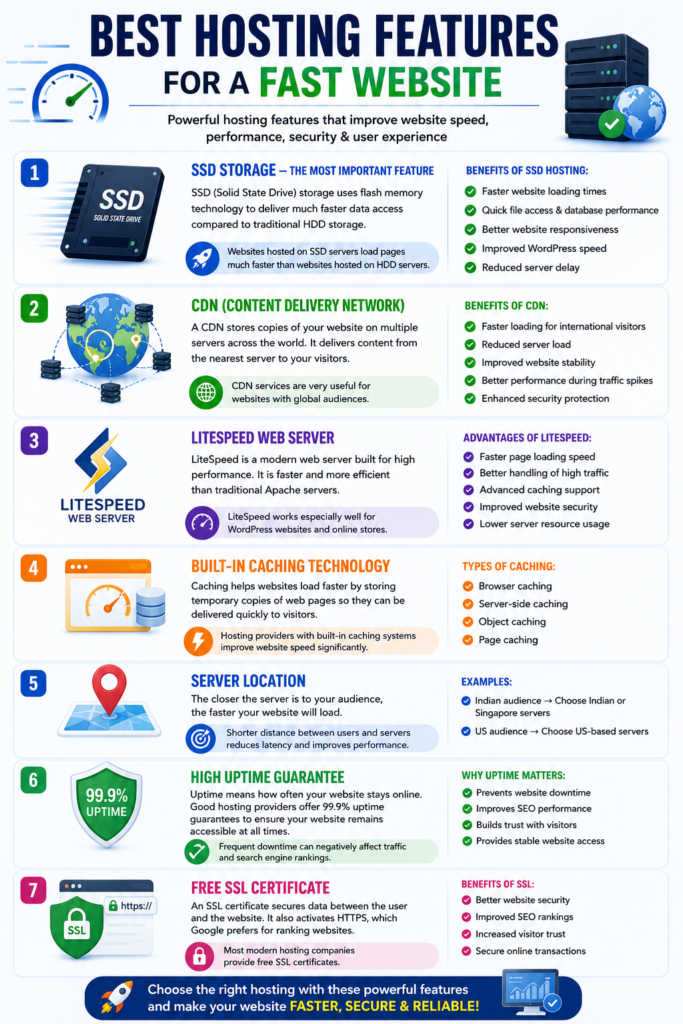
1. SSD or NVMe storage
Older hard drives (HDD) use moving mechanical parts and are slower. SSD storage uses flash memory and reads and writes data much faster, and NVMe is faster still. This helps file access, database queries and WordPress speed.
2. CDN (Content Delivery Network)
A CDN stores copies of your site’s files on servers in many locations. When someone opens your site, files come from the server closest to them. This speeds up loading for distant visitors and reduces load on your main server.
3. LiteSpeed web server
LiteSpeed is a modern web server that many hosts use instead of the older Apache. It handles traffic efficiently, works well with caching and is a good fit for WordPress sites and online stores.
4. Built-in caching
Caching saves ready-made copies of your pages so the server does not rebuild them for every visitor. Common types are browser caching, server-side caching, page caching and object caching. Hosts with built-in caching can speed up your site without extra plugins.
5. Server location
The closer your server is to your visitors, the faster your site tends to load. If your audience is in India, choose a server in India or a nearby location such as Singapore. For a US audience, choose a US server.
6. Uptime guarantee
Uptime is how often your site stays online. Good hosts promise about 99.9%. Frequent downtime frustrates visitors, and long outages can affect your search visibility.
7. Free SSL certificate
An SSL certificate encrypts data between your visitor and your site and turns on HTTPS. It builds trust, protects form data and is a small Google ranking signal. Most modern hosts include it free.
Shared hosting vs VPS vs cloud: which is faster?
| Type | Good for | Speed and resources |
|---|---|---|
| Shared hosting | Beginners, small sites | Affordable, limited shared resources |
| VPS hosting | Growing sites | Dedicated resources, more control |
| Cloud hosting | High-traffic sites | Highly scalable with strong uptime |
For beginners, fast shared hosting with SSD storage, LiteSpeed and caching is usually enough. Upgrade only when your site actually becomes slow or hits resource limits.
Common hosting mistakes beginners make
- Choosing hosting based only on price
- Ignoring server technology and caching
- Not checking the uptime guarantee
- Picking a plan without SSD storage
- Using a server far from your visitors
Hosting is only part of speed. Large images, heavy themes and too many plugins also slow a site down. After you launch, test it for free on Google PageSpeed Insights and fix the issues it lists.
Final thoughts
A fast site comes from a combination of SSD or NVMe storage, a CDN, LiteSpeed servers, caching and a good server location. These features together improve loading speed, user experience and SEO performance.
Not sure how to pick a plan? Read our beginner’s guide to choosing the best hosting, or see what hosting costs in our India price breakdown.
2 thoughts on “Best Hosting Features for a Fast Website (Beginner’s Guide 2026)”